Until startups within the IoT ecosystem give their prospects 4x to 5x return on funding, their options won’t be adopted extensively. It’s higher to understand this within the pre-stages of creating an answer than after burning cash. So, they need to spend time with the client. Extra the time spent extra is the understanding developed on what the client actually desires to attain. Learn on for extra of such precious recommendation.

The Web of Issues (IoT) has been gaining significance in the previous couple of years however has witnessed elevated adoption after the havoc brought on by coronavirus. With compelled shutdowns everywhere in the world, industries now see IoT as a necessity to outlive available in the market.
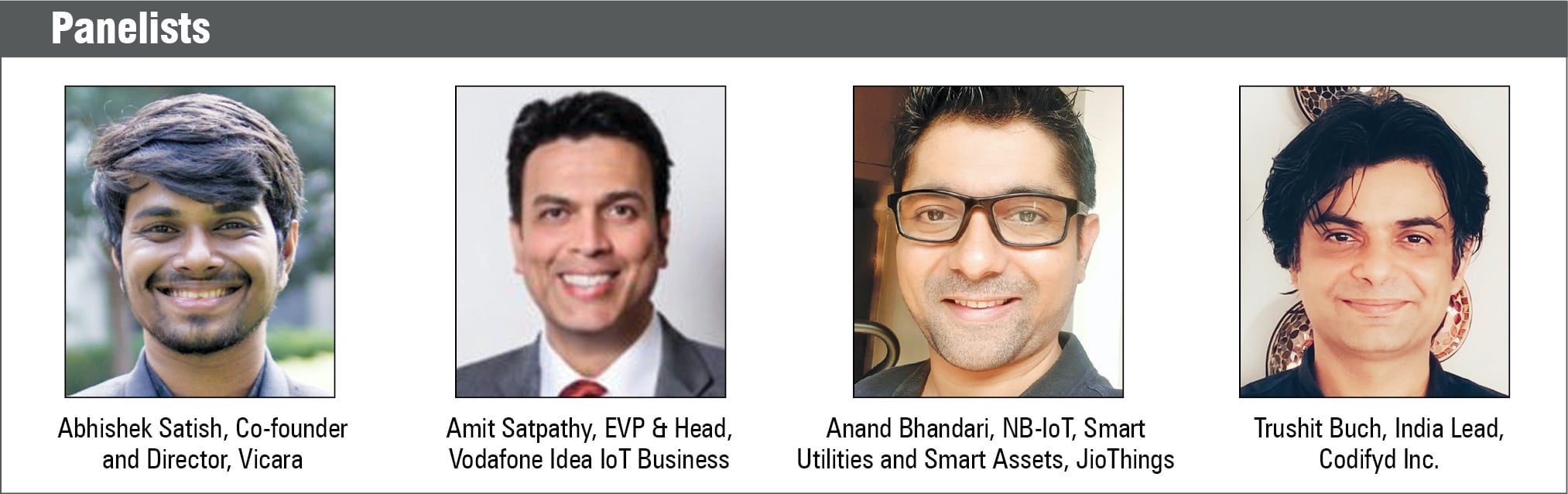
“IoT is a whole ecosystem of {hardware} by means of connectivity and platforms. Aftersale companies are essentially the most essential but uncared for side of this ecosystem,” says Anand Bhandari who heads NB-IoT, Sensible Utilities and Sensible Property at JioThings. He provides, “The journey of IoT can solely start when the ecosystem comes out of the blind-man-and-elephant state of affairs, every attempting to take a look at IoT from his personal prism.”
As per a examine achieved by Zinnov, there are over 1,200 public-listed giant enterprises in India with a present IoT adoption fee of round 35%. The Zinnov examine additionally discloses that India is without doubt one of the richest expertise ecosystems for IoT, with 30,000 to 40,000 professionals dedicatedly engaged on this know-how. But, specialists really feel that the adoption fee is way slower than any report on IoT has anticipated to this point.
The place the issue lies
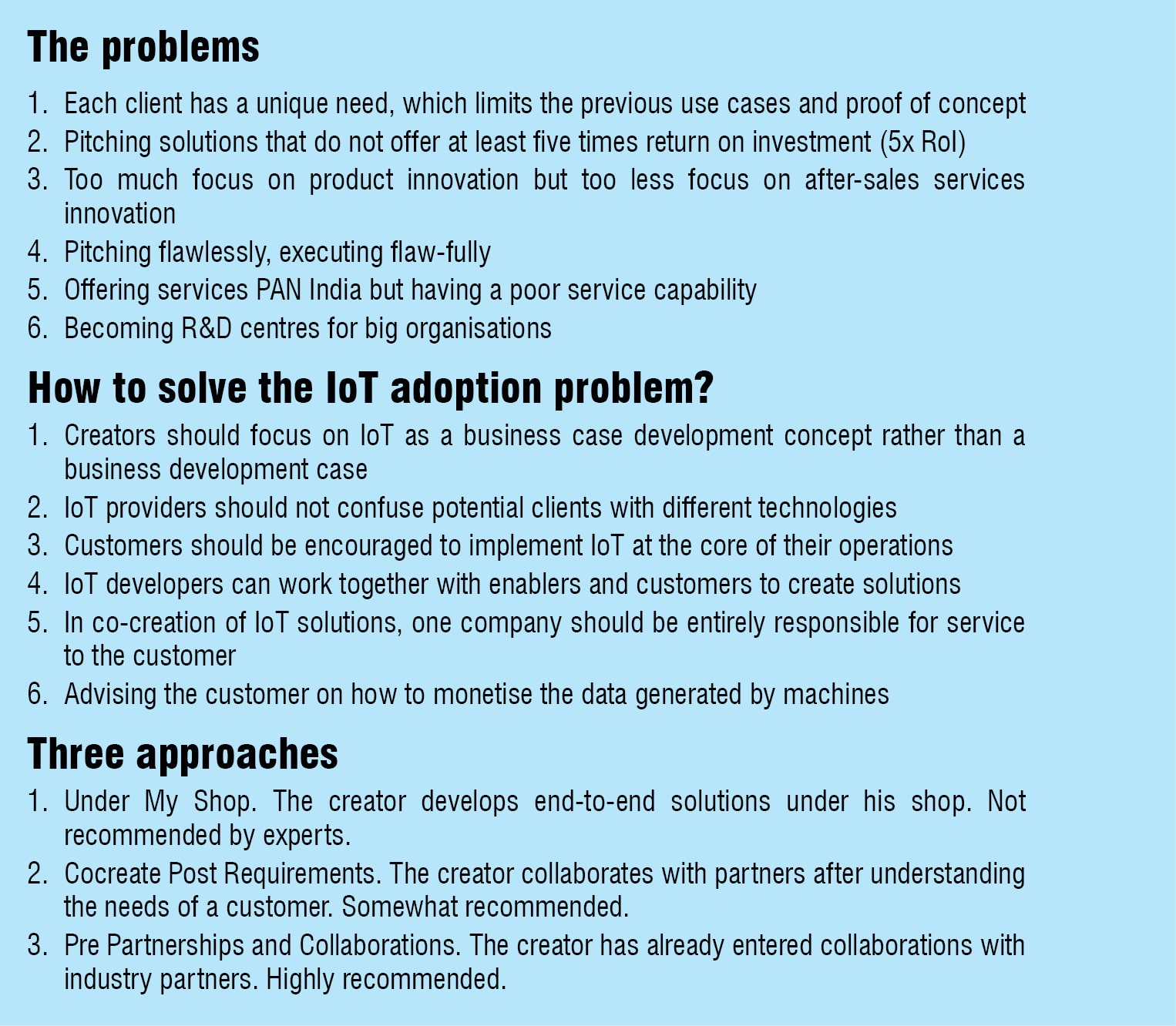
The issue lies each on the vendor in addition to on the client facet. Persons are at all times excited to speak about IoT and its implementation however offers between sellers and consumers don’t shut that simply. Sellers ought to focus extra on IoT options as a enterprise case improvement idea moderately than as a enterprise improvement idea.
“The enterprise improvement circumstances give IT heads and CTOs a purpose to push by means of to have inside groups on the identical web page of implementing IoT. I discuss to individuals who have quite a lot of fancy use circumstances, however nothing has made cash,” notes Amit Satpathy, EVP & Head, Vodafone Concept IoT Enterprise.
Moreover, completely different sellers may also be complicated prospects with completely different applied sciences and fashions. There’s a good variety of IoT sellers accessible available in the market, and this merely signifies that prospects have quite a lot of applied sciences and use circumstances to select from. Nevertheless, quite a lot of choices within the know-how could be complicated consumers greater than they’re serving to them determine. What provides extra worries to the prolonged listing of choices is the truth that just a few give attention to what the client desires to attain by means of the IoT. A lot in order that even the nice ones seem like below the identical shade as ones promising fancy use circumstances.
“Going by means of so many applied sciences makes the client take into consideration how quickly they are going to mature extra. The purchasers merely say that they are going to look forward to the know-how to get extra mature earlier than making a call. As no person’s specializing in the end result, and the client is totally confused, they hold suspending their resolution saying, okay, positive. Let me achieve extra information. Let this factor mature,” explains Amit.
Then comes the apprehension related to implementing Business 4.0 measures in an organisation. Many organisations trying to profit from Business 4.0, generally known as IIoT, are not looking for the know-how applied on the core of their operations.
As a substitute, they have an inclination to get these options applied in areas the place there are quite a lot of people working already. These options find yourself dealing with resistance from individuals who have already been working in that area.
“For those who see the setup of a big organisation, you’ll discover that the man who enjoys quite a lot of energy is often sitting in a distant space, and the issue arises when this chief begins feeling that he’ll get redundant, and the issue amplifies when his workforce begins feeling that they will even get redundant,” notes Amit.
One answer for this may be to tell the client on the stage when he desires the reply to the place he ought to begin when it comes to implementing IoT. That, as per Amit, is the golden query that may break the ice between the vendor and the client. Amit can be of the view that the following 5 months, when it comes to IoT implementation, won’t be the identical because the final 5 years. The outbreak of Covid-19 has made companies interact in a battle for survival, and IoT is now being seen as a serious weapon to win this battle.
Cementing what Amit defined, a report by Markets and Markets notes that the worldwide affect of Covid-19 on the IoT market dimension is anticipated to develop from $150 billion in 2019 to $243 billion by 2021 at compound annual development fee (CAGR) of 13.7% through the forecast interval. The report additionally predicts that the nations falling below the APAC area together with India, China, and Australia will showcase an enormous base amidst the Covid-19 outbreak. For the report, nations in APAC accounted for greater than 42% of the overall put in good meters in 2018.
Subsequent in line as an issue affecting the adoption of IoT is the affordability parameter. There are studies claiming that there are billions of linked gadgets already current on the planet. Such studies additionally trace at IoT market being a possibility upwards of $10 billion.
Nevertheless, the irony, as per Trushit Buch, India Lead, Codifyd Inc, is that the majority of such studies don’t point out the precise addressable markets. He’s of the view that whereas such studies are nice for a consulting objective, they might not be nearly as good in terms of the sensible half.
“Major purpose in my thoughts is affordability. I believe the addressable market is form of pushed by the affordability of the answer that it supplies. IoT has been right here for some time, however we should always not miss the reality that large-scale producers form of survive quarter to quarter, and quite a lot of them see IoT as a science based mostly experiment. Therefore, a lot of the corporations put the identical below the tag of R&D division,” says Trushit Buch.
He provides, “Given these challenges, how does IoT come on the coronary heart of operations of such corporations? I believe what Covid has achieved is, it has modified the notion of IoT from could-not-afford to the could-not-survive-without-it standing. Clearly, it could be a development that might occur, however no person would be capable of get away from it because it occurs. The query on the finish of the day is, whether or not IoT implementation would be capable of generate an extra income channel or not, or is IoT ok to assist the organisation save large quantities of cash?”
“I second you on that. India was one hundred and fiftieth on the listing of most knowledge consuming nations when the information tariffs had been on the upper facet. However since knowledge grew to become cheaper, we’ve got turn out to be the primary shopper of knowledge. Affordability of IoT options accessible available in the market is a giant issue and problem certainly,” says Anand.
Apparently, a survey by Gartner notes that 47% of organisations the analysis and consulting firm spoke to, plan to extend investments in IoT. Nevertheless, the identical survey additionally discovered that 35% of the respondents had been trying to scale down their investments within the know-how.
The most important of those challenges comes when an organisation providing IoT companies goes on to discover a brand new case. The specialists agree that that is true usually, as a result of with each firm an IoT answer is pitched, the distinctiveness of the use-case additionally modifications. New use circumstances, in flip, have an effect on the affordability issue additional with extra analysis and improvement, and in some circumstances the proof of idea that must be established.
In most such circumstances the IoT supplier passes on the extra bills to the consumer to satisfy RoI. Information processing additional provides to the burden of extra prices as there are situations the place tens of GBs of knowledge will get generated in a single day. IoT suppliers, particularly startups, must discover a approach to compress this knowledge, which in flip would possibly make them lose a few of it within the course of.
“For those who’re doing one thing on IoT, it’s not one thing that’s been explored earlier than. It’s most likely a brand new form of use case. You don’t know what sort of numbers you may pitch them. How am I supposed to offer throughout, you realize, what’s the amount of cash you’re saving, or what worth you’re going to get, when this isn’t one thing that’s been applied earlier than?,” explains Abhishek Satish of Vicara.
One of many solutions to a lot of the issues talked about to this point could be co-creation. By co-creation, as Anand explains, IoT builders ought to work along with enablers and prospects to create the options. Anand is of the view that co-creation helps in crossing the chasm from pilot to real-use circumstances.
Collaborations and end-to-end options
Finish-to-end solutioning, not a brand new time period in enterprise however comparatively nonetheless an idea within the IoT vertical, stands for options that ship huge knowledge, perception, administration, operational effectivity, compliance, and automation as a way to cut back operational prices. These sorts of options aren’t current in giant numbers within the IoT enviornment, and the present ones are both too costly or require big-scale deployments. This merely signifies that a giant organisation trying to implement IoT options, or a small organisation trying to automate its processes, may need to spend a bombshell upfront. Then comes the dilemma of use-cases and PoC, which make the issue a chicken-and-egg story.
“If I’ve to bundle all of the options in an end-to-end factor, then I’ll find yourself with out-of-box necessities posted by each buyer. When it comes to plug-and-play options both I develop an end-to-end answer below my store, or I collaborate with completely different suppliers and attempt to make my answer reasonably priced. The great thing about the second mannequin is that these suppliers I’m working with have already got options, and people options are serving to me make an end-to-end answer attraction to a buyer in a significantly better and reasonably priced means, “ says Trushit.
Nevertheless, there may be a 3rd method, the method that begins with pre-integration. This method provides creators house to create options by collaborating with platforms, enablers, integrators, and implementers earlier than really reaching out to an organization for pitching options. That is completely different from the second method because the creator right here is engaged on an answer upfront, whereas within the second method the creator is engaged on an answer after getting an inventory of necessities from a possible consumer. Additionally, who to collaborate with within the third method is set within the pre levels, whereas within the second method a creator begins taking a look at potential collaborations after realizing what sort of answer is the consumer in search of.
“I see this as a possibility which nonetheless is a clean slate. If I’m aggregating a big sum of knowledge from a big producer, every product queue would have a sensor. I, as a producer, wouldn’t promote it to my buyer however I might be needing a distributor to promote that knowledge. This whole course of is painful as a result of it entails prices at each stage because of the presence of individuals at each stage. For those who can cost for that knowledge, the advantages embrace higher time to market. The info that you’ve given to an IoT firm is now providing you with cash in an iterative style,” feels Trushit.
Nevertheless, any end-to-end answer can’t be accomplished except there are a number of events concerned in creating and deploying that answer. Some examples of groups which are required to be concerned in any end-to-end answer are cloud groups, builders’ groups, purposes suppliers, edge computing groups, and extra. All these groups, in quite a lot of circumstances, can both be from the identical vendor or from completely different distributors.
Since, there may be an ecosystem engaged on the identical case, it could possibly find yourself making win-win for everyone. Such collaborations cannot solely assist democratise the information however it could possibly additionally open doorways for suppliers to work on particular options as a substitute of forcing them to work on every thing on their very own. The identical may assist deliver down the time required to develop options as completely different events are engaged on completely different facets of the identical.
“The one problem is folks must change the way in which they pitch options. As a substitute of claiming I present this, folks must say I’m answerable for this. Offering and transferring out doesn’t imply you’re involved in regards to the consumer,” says Anand.
The query of end-to-end solutioning can be extra pertinent from the client’s facet as it’s he who’s going to be spending on getting the answer deployed. Therefore, the advantages of the identical ought to be clearly seen to the client. Such options, as per Amit, ought to give extra readability on the end result to the patron. Most prospects are often centered on what they want and discuss much less about which applied sciences can assist them attain there.
“It, as an end-to-end answer, is best if it’s given to at least one service supplier. A small downside within the answer could cause a mad rush and blame recreation amongst all of the suppliers within the ecosystem,” feels Amit. He provides, “An end-to-end answer from a single supply reduces dangers and makes the one get together answerable for every thing that’s a part of that answer. Furthermore, innovation is way sooner with built-in IoT.”
From the answer supplier’s standpoint, the largest battle on this journey often begin when completely different items of the equation don’t match collectively. There may very well be occasions when the {hardware} accessible doesn’t combine nicely with the infrastructure of an organization, or there might be situations the place software-hardware integration turn out to be tough. These situations often go away creators and repair suppliers with only one choice, and that’s to start out every thing afresh.
For instance, a producer engaged on SMT traces might discover sensors not ok to collect knowledge that he actually desires. Equally, there may very well be manufacturing items the place warmth generated just isn’t permitting the sensors to perform correctly. Right here, higher sensors (the brand new ones) will price extra and would require extra time to be confirmed to work effectively.
“I believe the problems come if you find yourself constructing an answer and utilizing another person’s product. There’s solely a certain quantity of management that you’ve over what you are able to do with what’s accessible. So, as a supplier you have to at all times be clear on what you may construct from scratch and what it’s essential outsource to construct from scratch. Nevertheless, on the finish of the day, you as an organization ought to be accountable for the answer that you’re offering. This ought to be regardless of the variety of distributors working with you,” says Abhishek.
He provides, “You shouldn’t go to a consumer and inform him the issue was prompted as a consequence of a sure fault in a sure a part of the method supplied by a vendor of yours. No consumer wish to hear that another person is accountable if you had been the one who pitched and supplied the answer. Purchasers wouldn’t wish to run to third-party distributors in any case!”
An IoT answer makes absolute sense when the accountability for it to work flawlessly is taken completely by one get together. There is no such thing as a means a consumer would count on knowledge administration from another person and making the sensors perform the way in which they had been purported to from another person. Whereas there might be a number of distributors answerable for creating an end-to-end IoT answer, the accountability for ensuring that the answer works as per the requirements set ought to at all times be on the shoulders of 1 get together. There’s a saying that goes nicely in such state of affairs: Too many cooks spoil the broth!
The startup half
Given the current circumstances, there’s a clear mandate that the well being and medical business is at present main when it comes to IoT adoption. Hospitals, major care nursing houses, pharmaceutical corporations amongst different verticals of the well being and medical business are looking for and implement IoT options for the advantage of people. Nevertheless, shutdowns throughout Covid-19 have made the manufacturing industries suppose extra about IoT. The restoration within the manufacturing sector, as per a Deloitte report, might take longer to succeed in pre-pandemic ranges. Projections based mostly on the Oxford Financial Mannequin anticipate a decline in annual manufacturing GDP development stage by as a lot as 3.5% for 2021.
Distribution corporations, as per the Deloitte report, are investing in IoT at a substation stage to raised forecast demand. Sensible electrical energy meters are in reality the largest instance of how huge the IoT vertical is getting, and these good meters will possible allow extra IoT-related use case improvement.
Equally, managing and monitoring large-scale wind and photo voltaic farms can be an issue that may simply be addressed with IoT. The federal government of India has set a goal of attaining 175GW of renewable power capability. This goal contains 100GW of photo voltaic power and 60GW of wind power by 2022.
In healthcare sector, IoT-enabled gadgets like wristbands and good watches with coronary heart monitoring and coronary heart rhythm detection have already proved their value.

In agriculture sector, India has not achieved a lot when it comes to empowering it with IoT, regardless of a majority of India’s inhabitants relying on agriculture as their major supply of earnings. The federal government of India, as per the Deloitte report, is advocating using sensors in agriculture worth chain. The deployment of IoT sensors to gather and transmit knowledge in agricultural actions will result in the event of superior strategies in precision agriculture monitoring.
“Different sectors, reminiscent of automotive, metals, and mining, are additionally deriving important worth from IoT. Due to this fact, this permits us to foretell that IoT is anticipated to turn out to be a key funding space round later 2021, as soon as money flows enhance,” reads the report by Deloitte.
It’s essential for startups within the IoT ecosystem to understand that except the options they’re providing are giving their prospects 4x to 5x return on funding, the options won’t be adopted extensively. It’s higher to understand this within the pre-stages of creating an answer than after burning cash. Startups, usually, are often brief on finance, and such errors solely worsen their issues. One of the simplest ways to make it possible for the answer a startup is providing would ship that form of RoI begins with the time a creator spends with the client. Extra the time spent, extra is the understanding developed between the creator and the client on what the latter actually desires to attain.
“Startups mustn’t go too area of interest as nicely. This can be very essential that you simply take the primary few steps proper. Individuals who you associate with are extraordinarily essential. It’s higher to succeed in purchasers by means of an accelerator or an incubator as a substitute of going and pitching the answer to a consumer immediately,” advises Abhishek.
“What the startups have to do is, suppose extra on the execution facet. They’ve to have the ability to say that I would or may not be capable of assist pan-India operations, however I can positively assist 24×7 in Bengaluru, Delhi, Mumbai, or a area they’ve the strongest presence in. It’s often the execution that’s the harder half,” says Amit.
Startups, as per Trushit, mustn’t go an excessive amount of into innovation. The innovation that they need to give attention to should be when it comes to the after-sale companies they provide. They might work on innovation that helps them higher their connections with the business, companions, and their purchasers. The main focus ought to be on innovation for a vertical, after which how they’ll apply the identical innovation in several verticals.
Amit provides, “Startups mustn’t burn their cash on tweaking merchandise simply to satisfy calls for of a single consumer. They need to additionally restrain themselves from turning into R&D centres for giant organisations who supply them free-of-cost PoCs. The best way to do that proper is by collaborating with some giant reliable and clear organisations.”
“Initially, it takes a very long time, but when in the long term you’ll be able to get ten logos that are actually referenceable, you may create your kingdom on that,” says Trushit.
Moreover, startups ought to by no means underestimate the service half, as it could possibly assist with an incredible quantity of income. The most important areas the place IoT startups can begin are distant working, telehealth, and e-commerce. Distant working makes each enterprise a possible buyer, and startups ought to always remember that.
As Amit concludes, “Startups are the arteries of the IoT ecosystem!”
This text relies on a panel dialogue held through the IoT Startups Present on the Tech World Congress Platform.
Mukul Yudhveer Singh is a know-how journalist at EFY